
A Case Study in Preventive Environmentalism: The Critical Role of Literature Review
EXECUTIVE SUMMARY
In May 2018, our founder was commissioned by Poseidon Offshore Mining to plan a sampling survey on the coastal lagoon and mouth of Rio Choapa in Coquimbo, Chile. Poseidon provided data on gold occurrences in the tributaries of Rio Choapa.
Our Founder conducted a literature review and determined that if gold were present, it would have been sparsely deposited beneath reclaimed farmland.
This intervention prevented loss of the 250,000 US Dollars of investment which Poseidon was seeking, and devasting impact to both the local environment and agricultural economy.
RIO CHOAPA
Rio Choapa seemed to be a narrow meandering river which formed a coastal lagoon, separated from the Pacific ocean by a narrow spit of beach.
The working hypothesis presented by Poseidon was that gold would be transported from a number of mapped occurrences in Choapa’s tributaries in the lower Andes, and accumulated in the lagoon, or as an alluvial fan at the mouth of the river.
LITERATURE REVIEW
Our Founder approached the literature review with the aim to determine the whether the river flow rate was sufficient to transport gold particles. Although, no hydrographic data was found.
Secondly, determining the dynamics of the spit dividing the lagoon and the ocean would indicate the seasonality of the river system, if it would grow and shrink over months, this would offer some confidence that the system could exhibit times of higher energy. Analysis of satellite imagery indicated that the spit was growing, which is likely due to aridification on the region.
In the pursuit of qualitative data, the literature review found that Rio Choapa was described as “delta truncato” (Arriagada Gonzalez, et al., 2010). This prompted a re-evaluation of the system, using topographical transects using Google Earth. An example transect is shown in Figure 1.
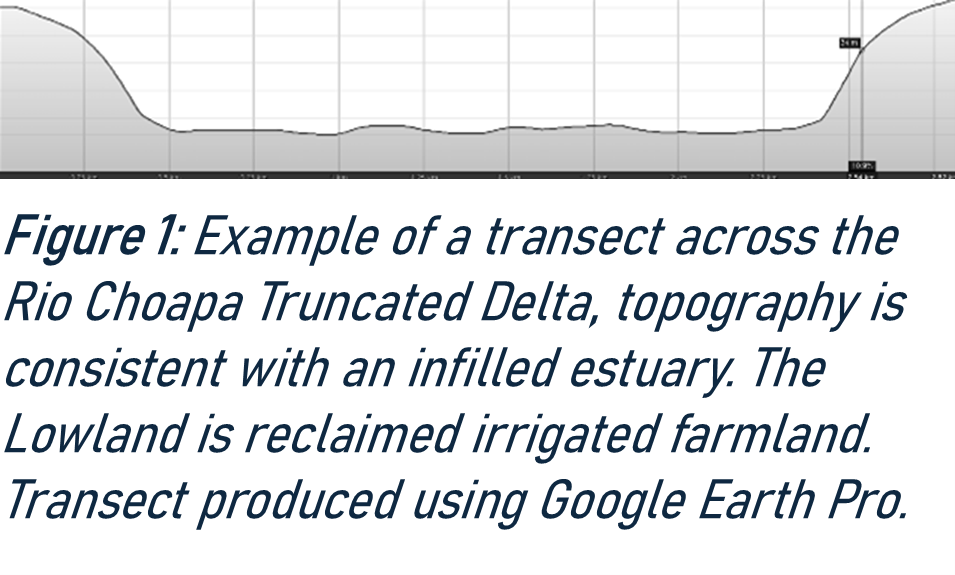
THE INTERVENTION
It was apparent that Poseidon’s understanding of the Rio Choapa System was flawed.
Our Founder presented that if gold were present, it would have been sparsely deposited in either an infilling estuary, or a low energy delta. As such, any deposit would be spread finely and buried beneath reclaimed farmland.
Our founder advised Poseidon not to proceed with this project, for which Poseidon had been seeking 250,000 USD of investment.
The recommendation was accepted by Poseidon, which likely prevented the significant loss of investment, local environmental destruction and the loss of the agricultural economy around the town of Huentelauquén.
LESSONS FROM CHOAPA
Literature Review is a critical step to determine and consider whether to proceed with a project.
In this case, it was particularly important to appreciate that data comes in many forms. Qualitative (descriptive) data was the key in re-evaluating he system as a truncated delta.
This description was found in a local journal article, written in Spanish. Leveraging local knowledge to inform project planning is highly advisable. The description could too easily have been overlooked, given a paucity of useful information at the outset.
As such, literature reviews must be conducted objectively, diligently and with integrity.
M-Cubed Research Consulting conduct a Literature Review as the first phase of our consultation for this reason.
An effective literature review allows for objective, considered, proposition on whether to proceed.
Literature Review also highlights the unknowns and sets out opportunity to contribute to academic scientific understanding.
CONCLUSION
By conducting a rigorous literature review and applying critical thinking, our founder was able to prevent a significant investment in a potentially unsuccessful project, protecting both financial resources and the local environment.
This case exemplifies the importance of a comprehensive and objective approach to project evaluation.
REFERENCES
Arriagada Gonzalez, J., et.al., 2010. Towards a Classification of the Delta Systems in Transitional Semi-Arid Chile Between the Rivers Copiapo and Aconcagua. Geogr. Fis. Dinam. Quat., 33(9), pp. 101-109.
 M-Cubed Research Consulting